We are helping by providing FREE nest cups!
 Click the image to see the video!
© Steve LaycockFollowing the very successful pilot scheme early in 2026, our Hampshire-wide nest cup scheme is now open.
Check the FAQs below and then request your nest cups HERE.
Artificial nest cups provide House Martins with safe, durable nests, and save them time and effort building their own. Unlike some mud nests, these nests don’t break or fall down.
Depending on the final total of funds available, we hope to fit up to 900 nest cups to about 260 properties before the 2027 breeding season starts.
To maximise the chances of them being used, the free nest cups will be fitted only to suitable buildings within 1km of other House Martin nests.
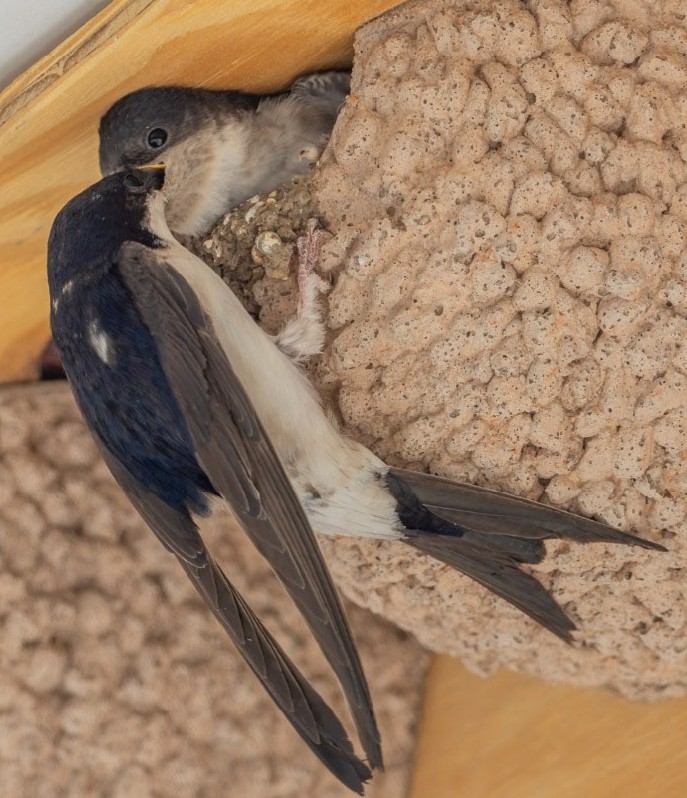
The photo shows one of the first batch of free nest cups in use at The Loddon School - click to see the video!
To help HOS provide these artificial nest cups, grants have so far been confirmed from: South East Water, Birds on the Brink, Stannah Lift Group, Thames Water, New Forest Biodiversity Forum Small Grant, New Forest National Park Authority's Sustainable Communities Fund, House Martin Conservation UK & Ireland and Portsmouth Water. One other application is ongoing - watch this space!
FAQs
How many nest cups can I request? Please ask for up to two sets of nest cups from the list (e.g. two front-facing doubles or one left off-centre double and one right off-centre double). If you are unsure which type would be best, please select 'Please advise'.
How do you decide which type of nest cup is best for each property? All the artificial nest cups come from Nest Cup Box. Most are front-facing doubles (with a sparrow prevention topper), fitted where the soffit overhang is at least 16cm and where there is a horizontal space at least 36cm wide.
House Martins really like a high gable apex and often choose to build the nest right in the top corner. Properties with a gable and overhanging soffits are ideal for left off-centre double cups (on the right side of the gable) or right off-centre double cups (on the left side of the gable). We do not attempt to fit nest cups at the very top because these have to be made with exactly the right angle.
If you have downward-sloping soffits and protruding rafters we may be able to provide bespoke single nest cups - please select 'Please advise', describe your eaves in the Notes section of the request and make sure your photos clearly show the underside of the eaves.
We do not provide nest cups for houses without overhanging eaves.
When we receive your request we will check your photos and if need be, contact you to agree which type of nest cup should be allocated for your property.
Why are photos of the property needed? Photos of proposed nest cup locations are essential to confirm the design of the eaves and which type of nest cups would be best. Please supply photos at the time of making your request, although you'll have another chance to send them by email afterwards. Without photos we'll not be able to progress your request.
Does it matter how high the roof is and which direction it faces? For ease of access and to maximise the chances of attracting House Martins, the height should be at second floor level. The birds will also need a clear flight path, unobscured by trees or other buildings.
This guide by House Martin Conservation UK & Ireland includes further information about the best aspect and ensuring nesting birds have sufficient shade from the sun.
Who will fit the House Martin nest cups? Hampshire Swifts fitted our first batch of nest cups early in 2026. For the countywide scheme, Paul Stevens will also fit many of the cups. Both have many years of experience climbing ladders to fit artificial nests for both Swifts and House Martins. In most cases they use rawl plugs and stainless steel screws. In some instances, for example where walls are tiled, they use mastic to ensure the nest cups are secure. Obviously, permission from the property owner to fit the nest cups is essential!
On the day of fitting, Tim or Paul will confirm which type of nest cup is best for your property and help you decide the best location beneath the eaves.
What about the mess from falling bird droppings and any ongoing maintenance? By positioning the artificial nest cups away from the front door or windows, issues with mess should be minimised. You may choose to fit a shelf beneath nests to catch droppings, although most people simply brush them away.
The nest cups shouldn't need any maintenance and are designed to last many years. None of the project partners (HOS, Funders, Nest Cup Box, Hampshire Swifts or Paul Stevens) are legally responsible for future maintenance, replacement or removal of the nest cups.
Why are the free nest cups restricted to properties within 1km of known nests? House Martins nest in loose colonies. This enables them to find mud and flying insects together, and warn each other of approaching predators. Artificial nest cups within or adjacent to existing colonies are much more likely to be used than elsewhere.
Why was the first free nest cup scheme restricted to only part of Hampshire? As part of an initiative to improve outcomes for Swifts, Swallows and martins across its supply area, South East Water funded the provision of House Martin nest cups in their water supply area in Hampshire. This enabled us to develop and test our application and installation processes before widening the scheme to other parts of Hampshire.
How quickly can House Martins be expected to use an artificial nest cup? More than 10% of the artificial nest cups fitted early in 2026 were used during the 2026 breeding season. However, there is anecdotal evidence that fledglings check out potential nest sites before migrating and return to use them the following year, so artificial nest cups installed before the 2026 breeding season are more likely to be used from 2027. We expect the countywide scheme to follow a similar pattern, with perhaps 10% take-up in 2027, increasing thereafter.
