
 The House Martin's white rump is distinctive
© Colin Bates  Their underside is white, with no breastband or dark throat. © lan Lewis
REQUEST FREE ARTIFICIAL NEST CUPS HERE
The Hampshire House Martin Project, led by Hampshire Ornithological Society, aims to raise awareness about House Martin declines, build our knowledge of nest sites and how many there are in Hampshire and provide artificial nests to boost breeding success.
In 2025 over 500 nest sites, with over 2,000 nests were reported by about 400 people across Hampshire, far more than we expected. During 2026, further reports included many new sites.
Early in 2026 we fitted 249 nest cups in north and east Hampshire, 27 of which were used. We're now offering nest cups countywide!
In 2027, we plan to conduct a structured survey to find out how many pairs of House Martins nest in Hampshire.
 The layers in this part-completed nest suggest that suitable mud was available only intermittently. © David Thelwell
An endangered species
Each April and May, House Martins return from Africa to spend the summer in the UK. They catch flying insects on the wing and build their cup-shaped mud nests under the roofs of houses and other buildings. Often, they form colonies with several nests in close proximity.
Hampshire Ornithological Society encourages the recording of all bird species in Hampshire. Some are doing well but the House Martin seems to be getting scarcer. Reflecting a wider decline, the House Martin has recently been added to the Red List of Britain’s most endangered birds.
With your help, we want to measure the scale of the problem and do something about it.
 Collecting soft, sticky mud for a nest. © Edward Butler
What's the problem?
Where ponds and other insect-rich habitats have deteriorated or when the weather is poor, a lack of insects may make it difficult for them to find sufficient food.
Sometimes it is difficult for them to find soft mud from which to build or repair their nests.
Their nests stick less easily to modern plastic soffits and may fall off, killing eggs and young and wasting weeks of time and nest-building effort.
Predators such as Magpies and Sparrowhawks take young from nests and often damage the nests in the process.
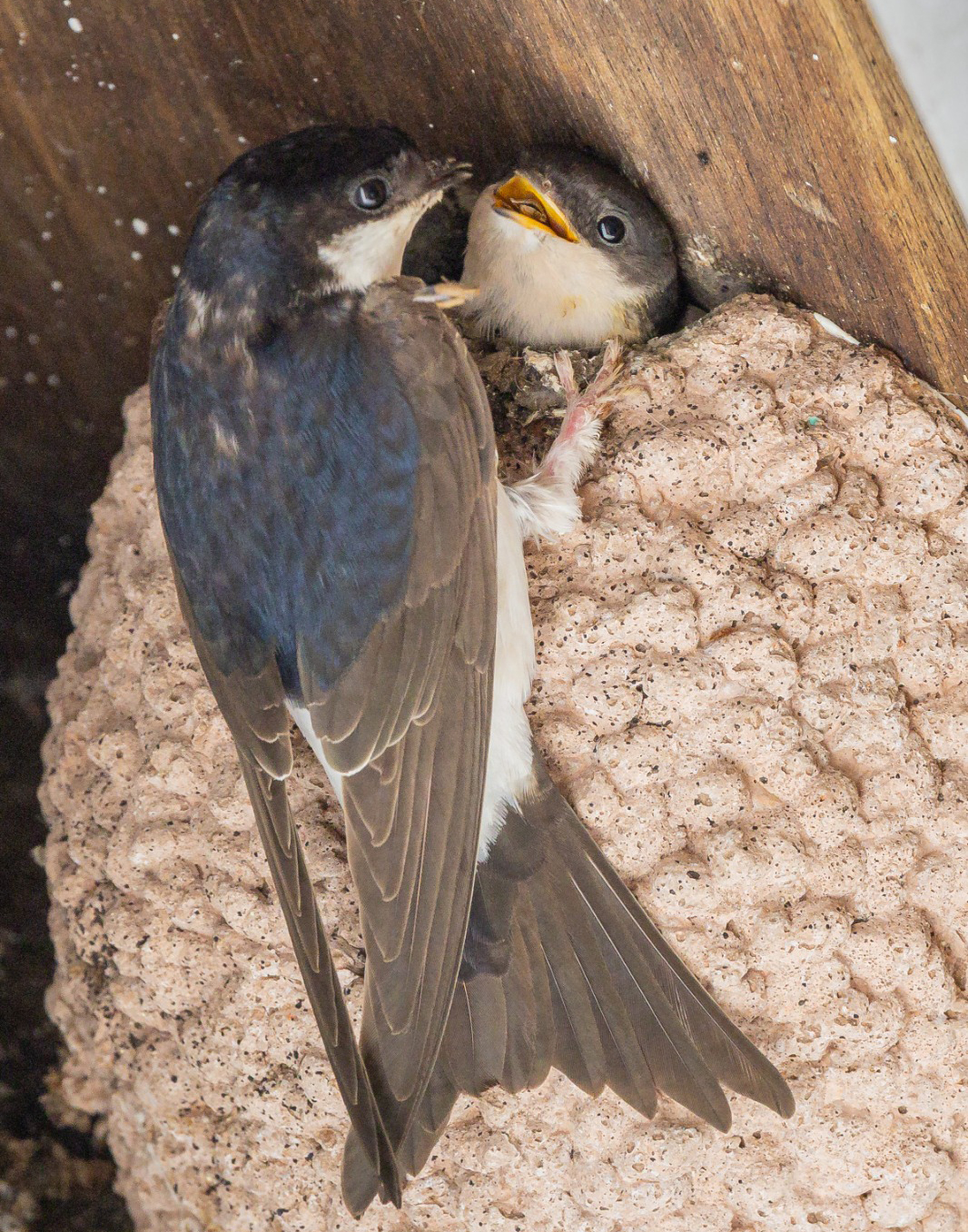 Click to see the video. © Steve Laycock
How can we help?
Potential solutions include reducing our impact on the climate, managing gardens and the wider countryside in wildlife-friendly ways and providing artificial nest cups.
Analyses of nest site data gathered in 2025 showed that House Martins had a strong preference for buildings with wooden soffits/fascias (over UPVC), presumably because their nests stick more strongly to the rougher wood texture. They also preferred locations close to livestock and freshwater habitats – here it’s probably easier for the birds to find insects to eat and suitable mud for making nests.
Some of the artificial nest cups we've fitted are already in use. They save House Martins valuable time, make the nests more robust and should boost breeding success. Click to see the slow motion video of a chick being fed in one of our artificial nest cups!
You will find further information about House Martins and how you can help them on the website of House Martin Conservation UK & Ireland.
Questions about the Hampshire House Martin Project should be sent to